White Pebbles
Hansel and GretelThe White Pebbles are the small, deliberately placed markers that let Hansel and Gretel find their way home after the Woodcutter and Stepmother leave them deep in the forest. Gathered in secret and made visible by moonlight, they turn Hansel’s forethought into a path the children can follow—and establish a sharp contrast with the less durable trail he tries to make on their second journey.
Gathering and Use
After overhearing the plan to abandon the children, Hansel goes out into the garden at night and fills his pockets with White Pebbles. The next morning, as the Woodcutter and Stepmother lead the children toward the forest, he drops the stones one by one along the way, slowly and stealthily. Their usefulness depends on this careful preparation: the stones are laid before the children are left, creating a route back rather than a rescue that must be improvised once they are lost.
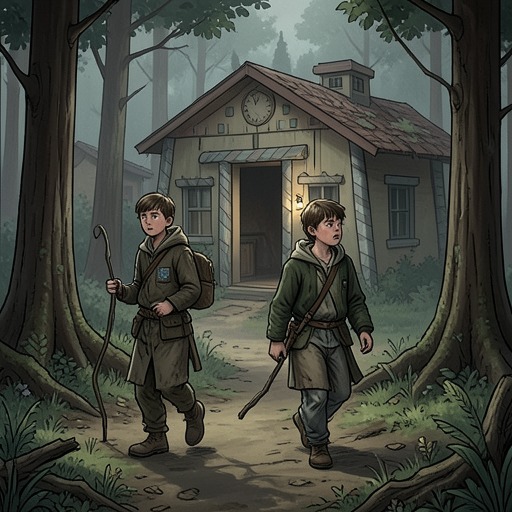
The adults leave Hansel and Gretel beside a fire, seated on a fallen tree, and tell them to wait. The children remain there for hours. As darkness comes, Gretel wants to return, but Hansel persuades her to wait until the moon rises. When its light falls on the White Pebbles, the scattered markers become a visible track, described as resembling a path of silver. What Hansel placed inconspicuously by day can now be seen in the dark.
The First Return
The White Pebbles guide the children through the forest and back to their father’s door the following morning. Their return reverses the abandonment’s intended outcome: the route that was meant to make them lose their way instead enables them to get home. The Woodcutter is overjoyed and regrets what he has done, while the Stepmother is furious. The stones therefore mark not only a physical way back but the immediate consequence of Hansel’s secret countermeasure: the family is together again, at least for a time.
Contrast with the Second Trail
When a worse famine leads the Stepmother to persuade the Woodcutter to abandon the children again, Hansel cannot collect more White Pebbles. The Stepmother has locked the door so the children cannot slip outside. He instead drops pieces of bread along the route. This substitution exposes the limits of the earlier method: Hansel’s successful plan depended on having access to the garden and time to gather durable markers before setting out.
The bread does not serve as a lasting trail. The birds of the forest eat the crumbs, leaving nothing for Hansel and Gretel to follow when they try to return. Against that failure, the White Pebbles’ solid visibility and successful guidance stand out. The two trails make the difference between a route that remains available under moonlight and one that can disappear through the actions of other creatures.